Smart Next Actions
- Continue to create book reviews to increase the effectiveness of my digital 2nd Brain and accelerate the learning of others.
- Continue to create video book reviews to crystallize, share, and demonstrates the importance of always thinking strategically.
- Continue to narrow the focus of Involgize on, quietly, targetting the unique educational needs of males of African descent.
- Continue, strategically, to acquire; read; and apply the knowledge from branding books.
- Continue to record and document (marketing) the reading of books and crypto documents every week.
- Continue to be conscious that how you look and everything you do, say, and wear is marketing Involgize directly and indirectly 24 hours a day.
- Continue to focus your intellectual energy, power, and organisation on mastering trading (Involgize Capital).
- Continue to strengthen the perception of Involgize being all about the highest levels of the single word “intelligence.”
- Continue to contract Involgize to be about the power of reading (in order to advance strategic thinking).
- Keep Involgize out of all mainstream organisations or institutions.
- Continue to use Involgize to create a new educational category concerning how to read extensively to solve-problems.
- Continue to create Involgize intellectual property documents.
- Continue to remain low-key and underground, shying away from any mainstream coverage or organisations.
- Continue to not market Involgize Capital, but keep it simmering in the background.
- Continue to make Involgize take reading and listening to books in new directions (expanding the category).
- Acknowledge that as long as Involgize remains out of public view then it is likely to remain one of a kind.
- Acknowledge that the perception of quality will come down to the consistency and quality of the every day marketing, and the standard of the products or services when the audience come into contact with them.
- Remember that you don’t have to make any major changes artificially, just continue to develop things in a organic way to continue receiving divine guidance and instruction.
- Acknowledge that by focusing the marketing on intelligence (books, etc) it is likely to create the sense of things being of a higher quality (specialist), as opposed to a jack of all trades by revealing that you are a lawyer and trader, etc (generalist).
- Continue to market consuming a range of information to, actually, increase your intelligence as well as improve the perception of being one of the smartest.
- Continue to develop Involgize’s unique intelligence program (a by-product of 1000+ books).
- Continue to not push the brand, but rather to push the importance of discovering your Genius and reading strategically.
- Acknowledge that a strong brand by its very nature has no boundaries so it will always be global.
- Acknowledge that any global perception of Involgize being a strong intelligence brand will in part be due to the perception of the British upper class being very clever people. In truth, ironically, in their absence there would have been no need to create the brand in the first place.
- Remember that a strong brand takes decades, not years, to build.
- Continue to use your online presence as a medium until it may be time to have, or partner with others, who carry out online activities as a business.
- Consider the idea of becoming low-key famous in order to ensure that the idea of Involgize spreads rapidly and successfully.
- Continue to assess the branding activities and abilities of crypto projects in light of “The 22 Immutable Law of Branding.”
Smart Learning Points
(Elaboration)
- “The objective is to create in the mind of the prospect the perception that there is no other product on the market quite like your product.” In other words, can you create in the minds of others that there is no other product or service on the market quite like Involgize? In term of… (1) teaching individuals how to think (strategically)… (2) teaching others how to read and process information easily and quickly… (3) showing people what information to consume strategically… (4) providing an intelligence blueprint (education) that is private and individualised… (3) providing Involgize clothing and armbands and so on.
- In light of the fact that no one brand can possibly appeal to everybody, this reminds me to continue to cater Involgize to the frequency (the demographic) in order to reveal the power of fusing street and true knowledge with the work-ethic of people with nothing to lose. This will be carried out with the inner-understanding that what will be created will also make up for the shortcomings of the education system in general, especially in light of the superior knowledge that is now available within the Information Age.
- That the power of a brand is in its narrow focus. The more the brand expands to encompass other things then the more diluted the power of the brand becomes in the minds of others. What this means for me is that if I desire to take Involgize in a new direction, then I should create a new brand that will be separate and distinct to the extent that others will not be able to detect that my two brands have the same source. However, in my case, Involgize Capital is an intellectual experiment designed to strengthen, test, and prove the power of Involgize Limited’s learning process. Therefore, I’ve decided to keep the two brands connected as I want the minds of the audience to grasp the point at a deeper level and see the connection immediately. That said, if I embark upon a third Involgize intelligence experiment, I will probably give this entity a completely different name and orientation in order to sufficiently stick to the best rules of branding (resist the urge to dilute the perception of the brand in the minds of others).
- “Marketing is not selling. Marketing is building a brand in the mind of the prospect.” So, essentially, what I have been doing on instagram is learning how to build a perception of intelligence for Involgize in the minds of an audience. This currently involves me reading books per week around various subjects (with an emphasis on financial intelligence: trading) and carrying out short video book reviews. The reasoning is that an audience will be able to see and hear me talk about various important and powerful subjects during a short period. It is this short space of time that they will be able to witness, live, the power and speed of accelerated learning, and the rapid change that it induces. When seen over longer periods, it confronts the viewer with an intellectual dexterity that seems almost impossible to achieve, strengthening the Involgize brand further. So “marketing is branding, and branding is marketing.” As long as I continue to read every week and complete video reviews then, in theory, Involgize should grow stronger and stronger. The reverse is also true. If I stop reading and making videos about the importance of thinking strategically, then the brand should become weaker and weaker.
- This text has reminded me that everything with a name (ourselves especially) is a brand, it just a case of whether we appreciate this point or not. Every aspect of a company is it marketing department, making every single part of the organisation (by default) its branding department too. So once we are aware of this, it is now just a case of deciding what we want all the parts of ourselves and our company to say! I want Involgize to scream phenomenal intelligence and financial sophistication.
- We must always… “aim high, as we cannot achieve higher than we aspire too.” For me, at the moment, that mean creating a truly profitable trading and investing company in the shadows.
- People will want to use a single word to describe me or Involgize. The easier it is to describe what Involgize represents, and is about in a single word, then the better. In this respect, the word that comes to my mind is “intelligence.” Others have said that in their opinion I may be the “smartest,” and I often describe Involgize as the building of an “intelligence culture.” I guess that reading books every week and carrying out book reviews to share the strategic importance and power of key books (year after year) will continue to tremendously strengthen this perception of me and the brand. I would also add that detailing the use of different intelligences to master our Genius will apply further weight to the idea of Involgize being all about intelligence.
- In terms of contracting Involgize so that it becomes more powerful in the minds of the consumer, this would probably mean focusing more on books and videos content that enables me to demonstrate the power and vital importance of thinking strategically.
- If I had to contract Involgize to make it more powerful, what would I do exactly? I would keep all marketing material and content focused on revealing the strategic power and benefit of books. Whether it will be trading and investing, physical training, crypto, and so on. Involgize could create a uniquely concentrated portrayal of the power of thinking strategically.
- This text has reminded me that if we intend on being super successful, then we have to do the things that others did before they became super successful. What immediately comes to my mind is Bill Gates, Jeff Bezos, Malcolm X, Marcus Garvey, and many others who read to transform themselves or build their businesses. Reading books is a category, and the objective of any branding objective is to dominate the category. In my case, I believe that I may be building a whole new category which is to read books relentlessly, primarily, to think strategically in relation to discovering and master our unique Genius and purpose.
- Involgize has the capacity to generate favourable publicity in the media and on podcasts, but it is not the direction that I think will best fit the experimental long-term goals and intention of the brand.
- This book has just confirmed that the reason why Involgize finds it quite easy, at the moment, to generate favourable publicity is because it is the first of its kind in a new category that has never existed before (it is creating a new category).
- Reminded that what others say about Involgize will always be more important than anything I personally say about it. This appears to validate my current approach of spreading the culture by going one person at a time. Ensuring that each person has full access to the non-publicly available intellectual property documents (prepare the documents for this coming Saturday’s meet-up).
- There is a role for advertising once a brand has been formed. Advertising will keep the brand awareness healthy within the minds of others. “First publicity then advertising is the general rule.” Advertising needs to be seen as something that protects the business against competitors attack of the market share. And not as something that will create further revenue.
- If Involgize was to start advertising, then we would have to include within our adverts that we are the market leader in regard to teaching others how to how to think (discover and master their Genius strategically (quickly and most effectively)). I would argue that no one is going to be more effective at teaching others how to think (strategically) because everybody else is, or will be in due course, integrated (compromised) into the current system. The only way to stop this from being the case is to become decentralised and anonymous like Bitcoin. And the only way to consistently remain decentralised and unseen is to really, really, care about the people (consumers).
- “Intelligence” is the word that Involgize will seek to own in the minds of the target audience. A word that nobody else owns in terms of the new category that is being created. And all marketing and branding efforts will be focus on strengthening the association of Involgize with this word in the prospects mind (hence the importance of books and the consistent action of reading all of the time).
- The brand that is first and creates the category is the name that will be known to generically represent it.
- We can create new categories by simply narrowing our focus such as Involgize reducing the activities that it perfects, targetting a certain group of people.
- “… forget about the laundry list of wonderful attributes your product has….To get into the consumer’s mind you have to sacrifice.” This reminds me of the continued importance of ensuring that Involgize Capital continues to be kept simmering in the background. Overall, Involgize represents acquiring phenomenal intelligence quickly via reading or listening to books.
- “To be successful in branding a “prestige” product or service, you need to do two things: You need to make your product or service more expensive than the competition. You need to find a code word for prestige.” So in the case of Involgize Clothing this will mean, deliberately, pricing items similar to that of bespoke designer apparel. And the code word for prestige will be the actual brand name itself (Involgize).
- “Go back in history. By far the most successful brands are those that kept a narrow focus and then expanded the category as opposed to those brands that tried to expand their names into other categories.” For me, this would mean expanding the category of reading book to include doing it (1) strategically, (2) to aid the discovery and mastery of our unique Genius, (3) to read with a target number of books and grading system… (4) to do so in combination with utilising our other intelligences… (5) to use it to advance our trading and investing knowledge, and so on.
- “When Coca-Cola first made this claim customers instantly responded. “Yes,” they agreed. “Coke is the real thing. Everything else is an imitation.” Likewise, if we were to claim that the Involgize’s intelligence program has “no real competition,” or “is one of a kind,” the audience may also have no choice but to agree.
- It is not about quality per se, but rather, it is about building a perception of quality in the minds of the target audience. This is because, counter intuitively, the best quality products don’t often occupy the number one position in most markets. It is the services or products that are perceived in the minds of others as the best quality that take first place. Raising the question: how are you going to ensure that Involgize is perceived as the entity that provides the best intelligent information and products? Maybe by carrying out the following: keeping it underground… creating unique strategic video reviews, unique strategic book review documents, or unique clothing line to emphasis the message of multiple intelligences… with physical training videos to portray the message of multiple intelligences… drawing and sketching relevant images to demonstrate the power of multiple intelligences… and so on.
- “Take the law of contraction. What happens when you narrow your focus? You become a specialist rather than a generalist. And a specialist is generally perceived to know more, in other words to have “higher quality,” than a generalist.”
- Reminded that I am a specialist when it comes to accelerated learning and processing information strategically. I’m a generalist, however, when it comes to the type of information that I consume (law, crypto, finance, business, politics, artificial intelligence, personal-development, spiritual development, and so on). In fact, it is due to my generality (range) that I have come to know how to learn and process information powerfully in a specialised way. Consuming knowledge in a general way is in fact what seems to strengthen my ability and brand in regard to being one of the most intelligent. Thus, this suggest that it is extremely important that I continue to do so, and continue to document (market) the process as I have been doing successfully.
- When generalist go up against specialist, they will fail every time. However, when there is no real specialist competitions around then generalist can look like superstars.
- “The most efficient, most productive, most useful aspect of branding is creating a new category. In other words, narrowing the focus to nothing and starting something totally new.” So the question is can I start (or reinvent) something (reading) that has not been done before? Yes. I think the whole Involgize thing of reading 1000+ strategically (one after the other, year by year) by keeping a booklist and documenting the process online (2nd Brain) is something that has not been carried out before with a definiteness of purpose. And as a consequence, no one has formed an intelligence program quite like Involgize has or can.
- Involgize has to ensure that it uses one of the following words within the marketing: “the first”… “the leader”… “the pioneer”… or “the original.” Clearly, Involgize is the first to have a reading armband system and an intelligence program based on reading books strategically, making it simultaneously the “first,” the “pioneer,” and the “original” at the same time. So now everything should be about me continuing to promote the category of reading strategically. I do this by marketing my completion of books every week, carrying out book reviews about the strategic importance of crucial books, and documenting my continuous personal-development to reveal the tremendous power of this new category (strategic reading).
- The new category: “thinking strategically… reading strategically… acting strategically… reading fused with multiple intelligences… reading to discover one’s unique Genius and Purpose in life.” Essentially, promote reading strategically… the value of strategic knowledge… and letting others know what powerful books exists, (do not promote the Involgize brand). Use the brand, only, to remind and send energy to others (inspire) to find their Genius…master their Genius… and go all out intellectually!
- Do everything you can to welcome and encourage Involgize to have competitors (alternative spin-off brands) as this will, ultimately, enable to Involgize to grow faster.
- Do not follow the practice of extending Involgize’s name to different products and services in order to prevent the dilution of the brand. This does not mean that you cannot create merchandise (clothing), or services that assist Involgize to promote and demonstrate the power of this new category. But it does mean that it should never become a main focus concerning any marketing efforts. If there ever becomes a desire to make a spin-off activity the centre of attention, then a completely new brand and entity should be considered.
- New brands are needed, and are being created, in regard to education (hence EdTech) as the existing educational institutions have been extending their name brand to everything. That said, it is highly likely that Eurocentrism and a lack of racial intelligence will continue to be an unidentified and prevailing problem with any new education brand, and on any of these new platforms. For this reason, it makes sense to continue to keep Involgize, intentionally, outside of the mainstream in the name of achieving the highest levels of intelligence, and equipping others to be able to go inside and make the relevant changes necessary.
- Never copy what your competitor is doing on the basis that they must know something that you don’t. Stay focused, instead, on plotting your own path and direction. Rather, inspire them to watch and copy you as oppose to it being the other way around. For Involgize this has meant that… (1) the books on instagram have not been confined to personal-development books… (2) the marketing of reading and knowledge accumulation has not been Europeanised for a western audience… (3) Involgize content fuses black music with powerful knowledge to make it highly relatable to audiences of African-descent… (4) Involgize Clothing could be created to give expression to urban aesthetics, combining reading with the development of multiple intelligences… and (5) an aesthetic coloured armband system could be created to help create a new intellectual identity and culture.
- “The difference between building brands and milking brands.” Building the brand via consistent on-brand behaviour week after week after week. Milking brands: attaching other non-compatible brands to the main brand (and brand-extensions) that will inevitably start to dilute and weaken the brand’s central message. So, for me, that probably means stopping any focus on Involgize Clothing. But, rather, to keep Involgize targetted on books and intelligence as the core activity… it just so happens that we have merchandise like ivy league universities. And it just so happens that as an example for advanced students we use the things learned from Involgize to trade and invest in crypto-currencies and other financial markets (Involgize Capital).
- It’s simple. It is either we are working on building our existing brand or we are setting out to create a totally new one.“If the market is moving out from under you, stay where you are and launch a second brand. If it’s not, stay where you are and continue building your brand.”
- It is all about the power of the brand in the mind. The more powerful a brand is with its use of colour and marketing (consistent action, public speaking, book reviews, etc.) then the better.
- Remember that the brand will always come before the company. In other words, never let company business (wants and needs) or politics affect the perception of the brand in any shape or form.
- A key reason why, strategically, it is important for us to create strong personal brands is because a strong brand by its very nature is also global. It has not no borders or boundaries.
- “To be successful as a worldwide beer brand (or any worldwide brand), you need to do two things: You need to be first. Your product needs to fit the perceptions of its country of origin.” In the case of Involgize, it fits the perception of the upper class English being some of the smartest or most intellectual people in the world that strengthens the perception of the brand. Therefore, this may increase the odds that it can become a global brand as there is no such thing as a global brand with a global perception. The brand has to have some roots within a nation or country.
- The success of a brand is measured in decades not years. In support, it has taken me about 20 years (two decades) of work to come up with an Involgize intelligence blueprint that others will be able to use easily to accelerate their intelligence.
- “Markets may change, but brands shouldn’t. Ever.” In this respect, the suggestion is that a strong brand will also require the founder or representatives of the brand to never change also (not ruling out their continuous development though). “Brand building is boring work.”
- “What works best is absolute consistency over an extended period of time. Volvo has been selling safety for thirty-five years. BMW has been the ultimate driving machine for twenty-five years. And I (Involgize) have been reading strategically and developing my multiple intelligences for over 20 years.
- A narrow focus “… combined with consistency (over decades, not years) is what builds a brand.” This is why it was kind of inevitable that my consistent actions was able to used to create something like Involgize. Anybody can do something similar as long as they are willing to repeat a form of behaviour over at least a twenty year period (James Allen mentioned this casually within one of his books).
- What we think Involgize is does not matter, it is what our target audience think it is that is key.
- Involgize will not live forever. There will come a time when, after being born, the brand will grow-up, mature, then face a peaceful death. When this time arises, another brand may be created to start where it has left off.
- “What’s the singular idea or concept that you (Involgize) own’s inside the mind of the prospect?” Books and being one of the smartest (intelligence).
- This text confirmed my 10+ years experience of creating and developing my website. It can be either a business or a medium, but not both. In other words, either the website is setup to be a business so that all the focus has to be on generating traffic and revenue. Or the site can be a medium: a place to gather and document my thoughts and ideas. The objectives of one runs counter to the needs and desires of the other. Strategically, I choose to use it as a medium in the knowledge that by documenting my personal-development this may one day act as a foundation that can give birth to everything else such as wealth, culture, and so on (I was right!).
- Great offline businesses don’t become brilliant online companies just like recognised newspapers and magazines do not transition into amazing television programmes. This is because different mediums have different requirements and demands in order to succeed.
- Involgize has both tangible products (Involgize Clothing) and intangible products (book reviews, workbooks, videos, ideas). For the tangible products my website should be used to provide information, and for the intangible products it could be be pursued as a business.
- A lot of things in branding are counter-intuitive, hence the primary importance of reading. For example, who would of thought that having an easy and simple generic name online like pet.com… or shopping.com… would actually harm a business tremendously. This is because it does not bring anything distinctive to mind concerning the perception of the consumer. Common names don’t work offline so why would they work online? The whole idea of branding is to burn a brand’s name into people’s minds.
- Food for thought concerning Involgize: “if you are the CEO and you want your brand to become famous, you have to become famous, too.” Will we have to become low-key famous, I wonder, in order to achieve our objective? Probably! Hence the need to have an online presence and utilise social events to spread the ideas.
- “The internet is like a political contest… second place is no place.” But… “when the Web matures, of course, there will be opportunities for number-two brands.”
- To really, really, narrow Involgize’s focus so that it may be number one in a new category this could easily be achieved by making it narrowly about the intelligence of males of African descent.
- Involgize is and continues to be a source of information that prospects (people of African descent in particular) will not be able to find elsewhere.
- “Television brought truth to the Soviet people. When they were able to see the profusion of goods and services in the Western countries, they lost their faith in communism.” I suspect that a similar thing is currently happening with traditional finance being affected by Bitcoin and crypto. Once the population start to see the amount of wealth created in a short period by investing in Bitcoin and crypto-currencies, they will inevitably start to lose their faith in traditional finance portfolio management and asset allocation.
- It is because of the American company brands tend to be number 1 in their market categories around the world that provide the US with its global power and dominance.
- Creating a better product or service can only get us so far, as it is in building a better brand perception that will always be the key. “Perception is more important than reality.”
- “It’s hard enough to change the perception of a company. It’s impossible for one company to change the perception of a country. When you launch your Internet brand, you should try to match your product or service with your country’s perception.” This is the problem that I see with “WiCrypt” in the long-term. Because Nigeria has a perception of being an extremely corrupt country, this may have the inevitable affect of causing investor to want to pull out (dump the coins) of the project at the first sign of trouble. Even in the best case scenario, it is highly unlikely that a favourable perception of WiCrypt can change the overall negative ideas of Nigeria overall.
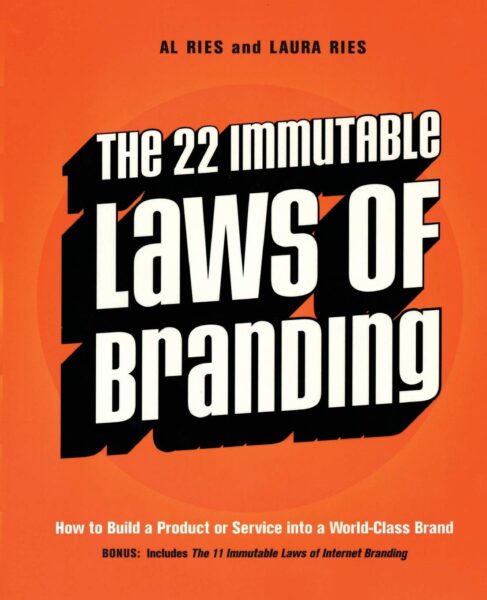
Key Sentences and Paragraphs from ‘The 22 Immutable Laws of Branding’
INTRODUCTION
“The objective is to create in the mind of the prospect the perception that there is no other product on the market quite like your product (p. 5).”
“Can a successful brand appeal to everybody? No. The same concept of singularity makes certain that no one brand can possibly have a universal appeal (p. 5).”
“The same forces that try to increase a company’s market share are also the forces that undermine the power of the brand (p. 5).”
“The same principles apply to almost every aspect of marketing. In the short term, conventional marketing strategies (expansion and line extension) can increase sales, but in the long run they usually undermine the power of the brand and decrease sales (p. 5).”
“Conventional marketing is based on selling when it should be based on branding. Marketing is not selling. Marketing is building a brand in the mind of the prospect (p. 5).”
“Marketing is brand building (p. 6).”
“If the entire company is the marketing department, then the entire company is the branding department (p. 6).”
“Any proper noun is a brand. You are a brand. And if you want to be truly successful in life, you should consider yourself a brand and follow the laws of branding outlined in this book (p. 8).”
“What this book will help you do is to apply brand thinking or the branding process to your business. In other words, to turn your water into Evian, or yourself into the next Bill Gates. Aim high. You can never achieve more than you aspire to (p. 8).”
“In addition, there are some unique circumstances about the Internet that pose special problems for branding. That’s why we originally wrote the book The 11 Immutable Laws of Internet Branding (p. 10).”
1 THE LAW OF EXPANSION
“The power of a brand is inversely
proportional to its scope (p. 13).”
“Short term versus long term. Do you broaden the line in order to increase sales in the short term? Or do you keep a narrow line in order to build the brand in the mind and increase sales in the future? (p. 14).”
“Marketers constantly run branding programs that are in conflict with how people want to perceive their brands (p. 15).”
“Customers want brands that are narrow in scope and are distinguishable by a single word, the shorter the better (p. 15).”
“If you want to build a powerful brand in the minds of consumers, you need to contract your brand, not expand it (p. 16).”
“In the long term, expanding your brand will diminish your power and weaken your image (p. 16).”
2 THE LAW OF CONTRACTION“
“A brand becomes stronger when
you narrow its focus (p. 17).”
“Good things happen when you contract your brand rather than expand it. The first stroke of genius in DeLuca’s case was in coming up with the name (p. 18).”
“Good things happen when you contract rather than expand your business. Most retail category killers follow the same five- step pattern (p. 19).”
“Narrow the focus. A powerful branding program always starts by contracting the category, not expanding it (p. 19).”
“Dominate the category. The ultimate objective of any branding program is to dominate a category (p. 19).”
“If you want to be rich, you have to do what rich people did before they were rich— you have to find out what they did to become rich. If you want to have a successful company, you have to do what successful companies did before they were successful. As it happens, they all did the same thing. They narrowed their focus (p. 20).”
3 THE LAW OF PUBLICITY
“The birth of a brand is achieved
with publicity, not advertising (p. 21).
“While a hefty advertising budget might be needed to maintain high-flying brands like McDonald’s and Coca-Cola, advertising generally won’t get a new brand off the ground (p. 21).”
“Anita Roddick built The Body Shop into a major brand with no advertising at all (p. 21).”
“It was the endless torrent of newspaper and magazine articles, plus radio and television interviews, that literally created The Body Shop brand (p. 21).”
“Today brands are born, not made. A new brand must be capable of generating favorable publicity in the media or it won’t have a chance in the marketplace (p. 22).”
“And just how do you generate publicity? The best way to generate publicity is by being first. In other words, by being the first brand in a new category (p. 22).”
“And the best way to make news is to announce a new category, not a new product (p. 23).”
“What others say about your brand is much more powerful than what you say about it yourself (p. 23).”
“But what works in branding today is publicity, not advertising (p. 24).”
“They’re wrong. Strategy should be developed first from a publicity point of view (p. 25).”
4 THE LAW OF ADVERTISING
“Once born, a brand needs advertising
to stay healthy (p. 26).”
“Today, everybody knows that Xerox pioneered xerography and has become a global leader in copiers. There’s no news story left to tell, so advertising takes over (p. 26).”
“First publicity, then advertising is the general rule (p. 27).”
“Leaders should not look on their advertising budgets as investments that will pay dividends. Instead leaders should look on their advertising budgets as insurance that will protect them against losses caused by competitive attacks (p. 27).”
“The list of leaders that advertise their leadership is very short. Most leaders advertise some aspect of their quality (p. 27).”
“Pick up a copy of any magazine or newspaper and flip through the advertisements. Almost every ad makes some type of better-product claim. That’s what they all say. But what happens when your advertising says, “Our product is the leader”? What does the prospect think? “It must be better (p. 28).”
“Advertising may not pay for itself, but if you’re the leader, advertising will make your competitor pay through the nose for the privilege of competing with you (p. 29).”
5 THE LAW OF THE WORD
“A brand should strive to own a word
in the mind of the consumer (p. 30).”
“If you want to build a brand, you must focus your branding efforts on owning a word in the prospect’s mind. A word that nobody else owns (p. 30).”
“And so it goes. The minute a brand begins to stand for something in the mind, the company that owns the brand looks for ways to broaden the base, to get into other markets, to capture other attributes. This is a serious error and one of the most common mistakes in branding (p. 31).”
“What word does Kleenex own in the mind? Kleenex owns the category word. Kleenex is tissue (p. 31).”
“Here’s the catch: You can’t become generic by overtaking the leader. Pepsi won’t become generic for cola even if the brand outsells Coke (as it once did in the supermarket distribution channel). You can only become generic by being the first brand and establishing the category (p. 32).”
“So what do you do if you weren’t the first in a category? Quite often you can create a new category by simply narrowing your focus (p. 32).”
“So you can forget about the laundry list of wonderful attributes your product has. You can’t possibly associate them all with your brand name in a human mind. To get into the consumer’s mind you have to sacrifice (p. 33).”
“To be successful in branding a “prestige” product or service, you need to do two things: You need to make your product or service more expensive than the competition. You need to find a code word for prestige (p. 34).”
6 THE LAW OF CREDENTIALS
“The crucial ingredient in the success of
any brand is its claim to authenticity (p. 36).”
“Go back in history. By far the most successful brands are those that kept a narrow focus and then expanded the category as opposed to those brands that tried to expand their names into other categories (p. 34).”
“Ask not what percentage of an existing market your brand can achieve, ask how large a market your brand can create by narrowing its focus and owning a word in the mind (p. 35).”
“The crucial ingredient in the success of any brand is its claim to authenticity (p. 36).”
“When Coca-Cola first made this claim customers instantly responded. “Yes,” they agreed. “Coke is the real thing. Everything else is an imitation” (p. 36).”
“Leadership is the most direct way to establish the credentials of a brand. Coca-Cola, Hertz, Heinz, Visa, and Kodak all have credentials because they are widely perceived to be the leading brands in their categories. When you don’t have the leading brand, your best strategy is to create a new category in which you can claim leadership (p. 37).”
““The largest-selling contact software” became the credentials for the new brand. Everywhere the brand name was used, the credentials were also used. In publicity, advertising, brochures, letterheads, calling cards. Even on the product box itself (p. 37.”
“Conventional thinking would have it otherwise. “The market is small. Nobody cares that we’re the leader. They don’t even care about maintenance software itself, otherwise they would be buying more of this kind of product. Forget leadership. We have to concentrate all of our efforts on selling the benefits of the category” (p. 38).”
“Never forget leadership. No matter how small the market, don’t get duped into simply selling the benefits of the category early in the branding process (p. 38).”
“For almost all of the hundreds of companies we have worked with around the world, we have found some credentials that could be exploited. If not, we created the credentials by inventing a new category (p. 39).”
“If this place was really good (goes the thinking), there would be a line out the door (p. 39).”
7 THE LAW OF QUALITY
“Quality is important, but brands
are not built by quality alone (p. 40).”
“Quality is a concept that has thousands of adherents. The way to build a better brand, goes the thinking, is by building a better-quality product. What seems so intuitively true in theory is not always so in practice (p. 40).”
“Building your brand on quality is like building your house on sand. You can build quality into your product, but that has little to do with your success in the marketplace (p. 41).”
“Quality, or rather the perception of quality, resides in the mind of the buyer (p. 41).”
“If you want to build a powerful brand, you have to build a powerful perception of quality in the mind (p. 41).”
“Take the law of contraction. What happens when you narrow your focus? You become a specialist rather than a generalist. And a specialist is generally perceived to know more, in other words to have “higher quality,” than a generalist (p. 41).”
“Being a specialist and having a better name go hand in hand. Expanding a brand and being a generalist tend to destroy your ability to select a powerful name (p. 42).”
“When General Electric tried to compete in household appliances, the GE brand was no match for the specialists (p. 42).”
“Mile-wide brands like General Electric and General Motors look strong, but in reality are weak (p. 42).”
“They look strong because they are well known and have been in business for decades. But when they go against the specialists, they are weak (p. 42).”
“Another factor in building a high-quality perception is having a high price. Rolex, Häagen-Dazs, Mercedes-Benz, Rolls-Royce, Montblanc, Dom Pérignon, Chivas Regal, Absolut, Jack Daniel’s, and Ritz-Carlton are all brands that benefit from their high price (p. 42).”
“A better strategy in a sea of similar products with similar prices is to deliberately start with a higher price. Then ask yourself, What can we put into our brand to justify the higher price? (p. 43).”
“There’s nothing wrong with quality. We always advise our clients to build as much quality into their brands as they can afford. (Hey, it might save you money on service costs later on.) But don’t count on quality alone to build your brand (p. 43).”
“To build a quality brand you need to narrow the focus and combine that narrow focus with a better name and a higher price (p.43).”
8 THE LAW OF THE CATEGORY
“A leading brand should promote
the category, not the brand (p. 44).”
“The most efficient, most productive, most useful aspect of branding is creating a new category. In other words, narrowing the focus to nothing and starting something totally new (p. 45).”
“You have to launch the brand in such a way as to create the perception that that brand was the first, the leader, the pioneer, or the original. Invariably, you should use one of these words to describe your brand (p. 45).”
“You have to promote the new category (p. 45).”
“That’s the way you build a brand. Narrow the focus to a slice of the market, whether it’s pizza takeout or gourmet takeout. Then make your brand name stand for the category (the generic effect) at the same time that you expand the category by promoting the benefits of the category, not the brand (p. 46).”
“Promote the category, not the brand. What EatZi’s calls the “meal-market” category (p. 46).”
“You need to put your branding dollars behind the concept itself, so the concept will take off, pulling the brand along with it (p. 46).”
“What happens when competition appears, as it inevitably does? Most category leaders just can’t wait to shift into a brand-building mode. That’s a mistake. Leaders should continue to promote the category, to increase the size of the pie rather than their slice of the pie (p. 46).”
“The rightful share of a leading brand is never more than 50 percent (p. 47).”
“Contrary to popular belief, what would help EatZi’s (and every category pioneer) is competition (p. 47).”
“Leading brands should promote the category, not the brand (p. 47).”
9 THE LAW OF THE NAME
“In the long run a brand is nothing
more than a name (p. 48).”
“But in the long term, the unique idea or concept disappears. All that is left is the difference between your brand name and the brand names of your competitors (p. 48).”
“In retrospect, no. In futurespect, maybe you would. At least the vast majority of the companies we have worked with almost always prefer line-extended generic names to unique new brand names (p. 49).”
“But the company’s strategies are based on building the better product or service, and the brand names it uses to accompany these products have little power in the prospect’s mind (p. 50).”
“The Asian practice of fielding a wide variety of products under the same brand name has drawn favorable comments from many business writers who don’t always look under the financial covers to find the real story (p. 50).”
“Throughout Asia you see the same pattern. Rampant line extensions that are destroying brands (p. 51).”
“When you contract a brand, you increase its power (p. 51).”
“East Asia does not have a banking problem, a financial problem, a monetary problem, or a political problem. East Asia has a branding problem (p. 51).”
10 THE LAW OF EXTENSIONS
“The easiest way to destroy a brand is
to put its name on everything (p. 52).”
“But that’s customer logic. Manufacturer logic is different. If volume is going nowhere, the manufacturer concludes it needs more (p. 53).”
“As a result, the marketplace is filled with line extensions in areas where they are not needed and is starved for new brands in areas where they are needed. Figure that one out (p. 53).”
“Why did Miller introduce Miller Regular, a brand which most beer drinkers have never heard of? Because Anheuser-Busch has regular Budweiser, Coors has regular Coors, and Miller didn’t have a regular beer. Don’t laugh. This is the way companies think. The competition must know something we don’t know. Let’s do the same thing (p. 53).”
“(And what can you say about Coors Rocky Mountain Spring Water? Born in 1990. Died in 1992. Mourned by no one. Not too many beer drinkers wanted to shift from beer to water.) The market, you might be thinking, is shifting from regular to light beer. That’s true. But it’s really two markets, and the best way to capture those two markets is with two brands (p. 54).”
“But there are no major beer brands that are not line-extended, you might have concluded. And you’re right. And what a wonderful opportunity for someone who understands the laws of branding (p. 55).”
“The issue is clear. It’s the difference between building brands and milking brands. Most managers want to milk. “How far can we extend the brand? Let’s spend some serious research money and find out” (p. 55).”
“Before you launch your next line extension, ask yourself what customers of your current brand will think when they see the line extension (p. 56).”
“If the market is moving out from under you, stay where you are and launch a second brand. If it’s not, stay where you are and continue building your brand (p. 56).”
11 THE LAW OF FELLOWSHIP
“In order to build the category, a brand
should welcome other brands (p. 57).”
“The law of expansion suggests the opposite. When you broaden your brand, you weaken it (p. 57).”
“Customers respond to competition because choice is seen as a major benefit. If there is no choice, customers are suspicious. Maybe the category has some flaws? Maybe the price is too high? Who wants to buy a brand if you don’t have another brand to compare it with? (p. 58).”
“Market share is not based on merit, but on the power of the brand in the mind. In the long run, a brand is not necessarily a higher-quality product, but a higher-quality name (p. 58).”
“That might be the law of wine, but it’s not the law of branding. One day some company will do in wine what Absolut did in vodka and Jack Daniel’s did in whiskey: build a big, powerful, worldwide brand (p. 59).”
“Similarly, the best location for a Burger King franchise is often across the street from a McDonald’s restaurant (p. 59).”
“Your brand should welcome healthy competition. It often brings more customers into the category (p. 60).”
12 THE LAW OF THE GENERIC
“One of the fastest routes to failure
is giving a brand a generic name (p. 61).”
“The fact is, these brands/companies are successful in spite of their names. We believe the primary reason for these corporate successes is the strategy and not the name (p. 62).”
“But the vast majority of brand communication takes place verbally, not visually. The average person spends nine times as much time listening to radio and television than he or she does reading magazines and newspapers (p. 62).”
“The Luxury Car Company would have gone nowhere, in our opinion. But Toyota took the word “luxury,” tweaked a few letters, and came up with Lexus, a superb brand name for a Japanese luxury car (p. 64).”
13 THE LAW OF THE COMPANY
“Brands are brands. Companies are
companies. There is a difference (p. 66).”
“With this caveat in mind, a company is a company as long as the name is not being used as a brand. A brand is a brand (p. 67).”
“Unless there are compelling reasons to do otherwise, the best branding strategy should be to use the company name as the brand name (p. 67).”
“The WD-40 Company produces the WD-40 brand. The Zippo Corporation produces the Zippo brand. The Coca-Cola Company produces the Coca-Cola brand. Neat, simple, straightforward, easy to understand (p. 67).”
“The view from the inside is totally different than the view from the outside. Managers must constantly remind themselves that customers care only about brands, not about companies (p. 68).”
14 THE LAW OF SUBBRANDS
“What branding builds, subbranding
can destroy (p. 71).”
“You can’t apply your own branding system to a market that sees things differently (p. 73).”
“(Customers don’t understand the megabrand concept at all.) (p. 73).”
“When you feel the need to create subbrands, you are chasing the market, you are not building the brand (p. 73).”
“Think simple. Think like a customer and your brand will become more successful (p. 74).”
15 THE LAW OF SIBLINGS
“There is a time and a place to launch a second brand (p. 75).”
“But there comes a time when a company should launch a second brand. And perhaps a third, even a fourth brand (p. 75).”
“Yet, in some situations, a family of brands can be developed that will assure a company’s control of a market for many decades to come (p. 75).”
“The key to a family approach is to make each sibling a unique individual brand with its own identity. Resist the urge to give the brands a family look or a family identity. You want to make each brand as different and distinct as possible (p. 76).”
“Black & Decker created a separate brand called DeWalt. In less than three years, DeWalt became a $350 million business, the market leader in professional tools, and the second-largest power-tool brand after Black & Decker (p. 77).”
16 THE LAW OF SHAPE
“A brand’s logotype should be designed
to fit the eyes. Both eyes (p. 80).”
“Since the eyes of your customers are mounted side by side, the ideal shape for a logotype is horizontal (p. 80).”
“Of equal importance to shape is legibility. Logotype designers often go way overboard in picking a typeface to express the attribute of a brand rather than its ability to be clearly read (p. 80).”
“What typeface does Rolex use in its logotype? Ralph Lauren? Rolls-Royce? Serif or sans serif? (p. 81).”
“The truth is, the words (Rolex, Ralph Lauren, Rolls-Royce) are what communicate the power of the brands. The typefaces used in their logotypes can help or hinder the communication process, but only slightly (p. 81).”
“Legibility is the most important consideration in selecting a typeface used in a logotype (p. 81).”
“The other component of the logotype, the trademark, or visual symbol, is also overrated. The meaning lies in the word, or words, not in the visual symbol. It’s the Nike name that gives meaning to the Swoosh symbol (p. 81).”
“A great deal of effort has gone into creating elaborate symbols for use in logotypes. Crests, shields, coats of arms, and other heraldic symbols have poured out of America’s design shops in great profusion. For the most part, these efforts are wasted. The power of a brand name lies in the meaning of the word in the mind (p. 82).”
17 THE LAW OF COLOR
“A brand should use a color that is the
opposite of its major competitor’s (p. 83).”
“White is the color of purity (as in a white wedding gown) (p. 84).”
“Black is the color of luxury (as in Johnnie Walker Black Label) (p. 84).”
“Is blue a good color for a farm tractor? No, but it’s more important to create a separate brand identity than it is to use the right symbolic color (p. 84).”
“Be honest. In your mind’s eye, doesn’t the world seem to be awash in Coca-Cola signs? And isn’t it hard to picture many Pepsi-Cola signs? Pepsi is out there, but the lack of a unique differentiating color tends to make Pepsi invisible in a sea of Coca-Cola red (p. 85).”
“When a FedEx package arrives, everybody can see that a FedEx package has arrived. It’s like an orange-and-purple suit in a sea of corporate blue (p. 86).”
18 THE LAW OF BORDERS
“There are no barriers to global branding.
A brand should know no borders (p. 87).”
“It’s not the only way to grow. In fact, the perfect solution to achieving both goals is to build a global brand. That means: Keep the brand’s narrow focus in its home country. Go global (p. 87).”
“Every country has its own unique perceptions. When a brand is in sync with its own country’s perceptions, that brand has the possibility of becoming a global brand (p. 88).”
“Can any brewery do the same? Of course not. To be successful as a worldwide beer brand (or any worldwide brand), you need to do two things: You need to be first. Your product needs to fit the perceptions of its country of origin (p. 88).”
“The perception of a country is important. There is no such thing as a global brand with a global perception (p. 89).”
“But it would be a major marketing mistake for Coca-Cola to abandon its American heritage (p. 90).”
“Every brand, just like every person, is from somewhere (p. 90).”
“It doesn’t matter where your brand is conceived, designed, or produced, its name and its connotations determine its geographic perception (p. 90).”
“But he didn’t listen. The company used the Swatch name while the car was under development (first in a joint venture with Volkswagen and then later with Mercedes-Benz). Recently, wiser heads prevailed and the name was changed to the Smart car (p. 90).”
“The choice of the Smart name for a global product illustrates a trend in global branding: the use of English words for brands that may have no connection with the United Kingdom, the United States, Canada, Australia, or any other English-speaking country (p. 91).”
“English has become the second language of the world. If you are going to develop a brand name for use on the worldwide market, the name better work in English. It doesn’t have to be an English word, but it should sound like one (p. 91).”
19 THE LAW OF CONSISTENCY
“A brand is not built overnight. Success
is measured in decades, not years (p. 92).”
“Markets may change, but brands shouldn’t. Ever (p. 92).”
“They may be bent slightly or given a new slant, but their essential characteristics (once those characteristics are firmly planted in the mind) should never be changed (p. 92).”
“As foolish as Coca-Cola beer might seem to you, conceptually it’s no different from Tanqueray vodka, Coors water, or Crystal Pepsi. Markets may change, but brands should stay the same (p. 93).”
“Brand building is boring work (p. 93).”
“What works best is absolute consistency over an extended period of time. Volvo has been selling safety for thirty-five years. BMW has been the ultimate driving machine for twenty-five years (p. 93).”
“A pity. Little Caesars had one of the best brands in the pizza category. The only brand focused on takeout. The only brand with an identity and a message. (Pizza! Pizza!) And now it has nothing. Another victim of the law of consistency (p. 94).”
“Run up a red flag whenever you hear the words: “Why should we limit ourselves? (p. 94).”
“You should limit your brand. That’s the essence of branding. Your brand has to stand for something both simple and narrow in the mind. This limitation is the essential part of the branding process (p. 94).”
“Limitation combined with consistency (over decades, not years) is what builds a brand (p. 95).”
20 THE LAW OF CHANGE
“Brands can be changed, but only infrequently
and only very carefully (p. 96).”
“Because nothing in life, nothing in branding, is ever absolute. There are always exceptions to every rule. And the law of change is the biggest exception to the laws of branding (p. 96).”
“What works in banking just won’t work in a fast-moving field like computers or consumer electronics. There’s not enough time for the “forgetting” process to take place (p. 98).”
“Customers are never wrong. That’s one of the many human traits that is so endearing and yet so frustrating from a branding point of view. When you try to tell customers that your brand is different than it used to be, they will reject your message (p. 98).”
“Funny and also true. What you think your brand is really doesn’t matter. It’s only what your customer thinks your brand is that matters (p. 98).”
“You can be sure that the concept that brought your brand to the dance is still firmly embedded in your prospect’s mind (p. 98).”
21 THE LAW OF MORTALITY
“No brand will live forever. Euthanasia
is often the best solution (p. 100).”
“While the laws of branding are immutable, brands themselves are not. They are born, they grow up, they mature, and they eventually die. It’s sad. Companies are willing to spend millions to save an old brand, yet they resist spending pennies to create a new brand. Once you understand the nature of branding, you’ll know when it is time to let your old brand die a natural death (p. 100).”
“Don’t fight it. For brands, like people, there is a time to live and a time to die. There is a time to invest in a brand and there is a time to harvest a brand. And, ultimately, there is a time to put the brand to sleep (p. 100).”
“A well-known brand that doesn’t stand for anything (or stands for something that is obsolete) has no value (p. 101).”
“The question is obvious. Why spend all that money on conventional photography if the market is going digital? Wouldn’t it be better to let the old system die a natural death and use the money to build a new digital brand? (p. 102).”
“Meanwhile, on the digital side of the street, Kodak is also making a serious error (and this might be its biggest mistake of all). Instead of launching a new brand, Kodak is venturing into the field with the Kodak brand name (Kodak Digital Science) (p. 102).”
“… when a revolutionary new category develops, the inevitable winner is a revolutionary new brand name (p. 102).”
“When videotape rentals of motion pictures became commercially feasible, the winning retail brand was not Sears, 7-Eleven, or any supermarket or drugstore chain. It was Blockbuster Video, a brand-new brand (p. 102).”
“When personal computers invaded the office field, the winning brand was not IBM, AT&T, ITT, Hewlett-Packard, Texas Instruments, Digital, Unisys, Motorola, Sony, Hitachi, NEC, Canon, or Sharp. It was Dell, a brand-new brand (p. 102).”
“It remains to be seen, but our best guess is no [you were right] (p. 103).”
22 THE LAW OF SINGULARITY
“The most important aspect of a brand
is its single-mindedness (p. 104).”
“But make no mistake about it. Loss of singularity weakens a brand (p. 104).”
“What’s a brand? A singular idea or concept that you own inside the mind of the prospect (p. 104).”
THE 11 IMMUTABLE LAWS OF INTERNET BRANDING
1 THE LAW OF EITHER/OR
“The Internet can be a business
or a medium, but not both (p. 107).”
“Great, you might be thinking. We’ll play the Internet right down the middle. We’ll treat it as another arrow in our marketing quiver. That would be your biggest mistake of all (p. 108).”
“That’s not surprising. Did any nationally recognized newspaper or magazine make the transition to television? No, they were all failures on the tube, most notably USA Today and Good Housekeeping. (USA Today on TV lost an estimated $15 million the first year and was canceled during its second season) (p. 109).”
“The Internet is the Internet, a unique new medium with its own unique new needs and requirements (p. 109).”
“Building a brand on the Internet cannot be done by using traditional brand-building strategies (p. 109).”
“Which leads to the first and most crucial decision you must make: For my product or service, is the Internet going to be a business or a medium? (p. 110).”
“Trust is an important ingredient in any retail business. If your customers don’t trust you, they are unlikely to continue to do business with you. You undermine that trust by speaking out of both sides of your mouth (p. 112).”
“Larger companies are big enough to have the resources to support both an Internet business and an off-line business. In general, however, they need to differentiate between the two by giving their Internet business a different name (p. 113).”
“Is the brand tangible or intangible? For tangible products the Internet tends to be an information medium. For intangible products, a business (p. 113).”
“Futurist Faith Popcorn goes even further. By the year 2010, she predicts, 90 percent of all consumer products will be home-delivered. “They’ll put a refrigerator in your garage and bar code your kitchen. Every week they’ll restock your favorites, without your ever having to reorder. They’ll even pick up your dry cleaning, return your videotapes, whatever you need” (p. 116).”
“It’s impossible to build a reputation as a store with great selection and low prices if you are schizophrenic, that is, if you have both physical stores and Internet sites (p. 116).”
“All you are doing is confusing people (p. 116).”
2 THE LAW OF INTERACTIVITY
“Without it, your Website and your
brand will go nowhere (p. 118).”
“Where a book could take months to produce (and still does, unfortunately), a newspaper could be produced overnight (p. 119).”
“The secret to branding on the Internet is your ability to present your brand in such a way that your customers and prospects can interact with your message. You’ll have to throw out many of the traditional ways of brand building (p. 120).”
“Why would you assume that you could publish a successful magazine or newspaper on the Internet? Where is the interactivity? (p. 120).”
“Print is print; the Internet is the Internet. Trying to combine the two is a serious strategic error (p. 120).”
“What works in one medium won’t necessarily work in another. As a matter of fact, chances are great that one medium’s success will be another medium’s failure (p. 121).”
“The big cable television brands—HBO, ESPN, CNN, A&E, MTV, QVC, Showtime, and Nickelodeon—were not line extensions of broadcast brands. They were new brands created especially for cable (p. 122).”
“… you have to build interactivity into your site, and you generally need a new name (p. 122).”
“It bears repeating. The difference between the Internet and every other medium is interactivity. Unless your site has this crucial ingredient, it is going to get lost in cyberspace (p. 122).”
“Interactivity is the ability to type in your instructions and have the site deliver the information you requested in the form you requested it. Check out Amazon.com (p. 122).”
“Don’t do it that way,” we suggested. “Make the screen interactive. Ask the person a series of questions, then let your computer tell the individual what his or her problem might be” (p. 123).”
“Will the Internet spawn successful medical and educational brands? Why, of course. These are disciplines based on interactivity [EdTech] (p.123).”
3 THE LAW OF THE COMMON NAME
“The kiss of death for an internet
brand is a common name (p. 24).”
“The kiss of death for an Internet brand is a common name (p. 124).”
“In the positioning age, the name was important. In the Internet age, the name is critical (p. 124).”
“In the absence of competition, people will buy from a site with a common name. But as sites are set up with strong “proper” brand names, the common-name sites are going to dry up and blow away (p. 129).”
“A generic name like E*Trade is weak. The mind thinks verbally, not visually (p. 130).”
““You can see the problem. The beer drinker goes into the bar and says, “Give me a Lite beer.” And the bartender says, “Fine. What kind of light beer do you want?” (p. 133).”
“If common names don’t work on the outernet, why should they work on the Internet? The problem is exactly the same. How do I get the prospect to remember my brand name and associate it with some positive attribute? (p. 134).”
“The whole idea of branding, on the Internet or elsewhere, is to burn your name in the mind (p. 135).”
4 THE LAW OF THE PROPER NAME
“Your name stands alone on the Internet,
so you’d better have a good one (p. 36).”
“The lure of the generic is so powerful that some companies have paid enormous sums for names that in the long run will turn out to be useless. A Los Angeles company bought Business.com for $7.5 million. (To whom it may concern: If you had bought this book for $18.95, you would have saved yourself $7,499,981.05). Some other recent purchases (p. 137).”
“When you are choosing a brand name for your Website, the first thing to ask yourself is, what’s the generic name for the category? Then that’s the one name you don’t want to use for your site (p. 138).”
“Schwab is a short name (six letters), but it is not a simple name because it uses six letters of the alphabet (p. 142).”
“… client to make the name more finger friendly by shortening it to Branders.com (p. 143).”
“Brands are cold, silent, and lifeless. Only a person can articulate the brand’s strategy, position, and objectives. The media want to interview people, not brands. And whenever possible, the media want to interview the CEO, not the brand manager (p. 149).”
“Relax and enjoy it. If you are the CEO and you want your brand to become famous, you have to become famous, too. The most famous brands usually also have celebrity CEOs. Microsoft and Bill Gates. Sun Microsystems and Scott McNealey. Oracle and Larry Ellison. Apple and Steve Jobs (p. 149).”
5 THE LAW OF SINGULARITY
“At all costs you should avoid being
second in your category (p. 150).”
“…“Nothing comes between me and my Calvins,” Brooke Shields once said. On the Internet nothing comes between the customer and the brand. There are no middlemen, no trade, no real estate developers, no need for leverage against the leader. It’s what Bill Gates calls “friction-free capitalism” (p. 151).”
“As a result, the Internet is more like a football game or a political contest. It’s the Law of Singularity. Second place is no place (p.151).”
“Or as a Nike television commercial once said about the Olympics, “you don’t win silver, you lose gold.” On the Internet, there are no silver or bronze medals. On the Internet, monopolies will rule. There is no room on the Internet for number-two brands. The Internet will operate more like the computer software industry, in which every category tends to be dominated by a single brand (p. 151).”
“One of the many advantages of friction-free retailing is that there is no one in between the customer and the manufacturer taking a cut of the transaction. The price you pay for the lack of friction, however, is the virtual disappearance of the second brand (p. 152).”
“But the Web lacks the visibility of the physical world. If everyone bought their books from Amazon.com, how would you know? It’s this lack of visibility that mutes the backlash against a brand leader (p. 153).”
“Not at all. It only means that there is no clear-cut furniture leader today. But tomorrow is another matter. In all likelihood, one furniture brand will get out in front of the pack and go on to dominate the category. What happened in books is likely to happen in furniture (p. 153).”
“What might that approach be? If the laws of branding are immutable (and we think they are), then you must do exactly the same thing that Amazon.com did. You must be first in a new category (p. 154).”
“If the Web was going to be a business for Borders and Barnes & Noble, then they would have needed different names on their Websites. With the same names, it is harder to create identities on the Web that are distinct and different from their identities in the physical world. Line extension strikes again (p. 154).”
“The winner will be the first brand to establish a dominant position in the prospect’s mind. Then the Law of Singularity will take over and dampen the market shares of the runners-up. Nothing succeeds like success (p. 155).”
“… “Earth’s biggest bookstore” not only stakes out a category for Amazon.com, but also makes a strong claim for leadership in the category. “Image, build, reinvent” does neither. In summary, don’t get discouraged if you’re not the dominant brand in a category. Just channel your branding efforts in a different direction. Just narrow your focus (p. 156).”
“When the Web matures, of course, there will be opportunities for number- two brands. Until that day arrives, you need to be the leading brand in your category or look for an opportunity to narrow the focus in order to create a new category you can be the leader in (p. 156).”
6 THE LAW OF INTERNET ADVERTISING
“Advertising off the Net will be a lot bigger
than advertising on the Net (p. 157).”
“When the name on the stadium is worth more than the physical stadium itself, you know that we live in an advertising-oriented world (p. 158).”
“Let us repeat that statement. The Internet will be the first new medium that will not be dominated by advertising, and the reason is simple (p. 159).”
“An Internet brand, on the other hand, will never suddenly appear before you unless you summon it to do so. Out of sight, out of mind (p. 162).”
“Make your brand a source of information that prospects cannot find elsewhere (p. 163).”
7 THE LAW OF GLOBALISM
“The Internet will demolish all barriers,
all boundaries, all borders (p. 165).”
“Soviet authorities, of course, blocked Western newspapers and magazines from crossing their borders, but they couldn’t block Western television signals (p. 165).”
“Television brought truth to the Soviet people. When they were able to see the profusion of goods and services in the Western countries, they lost their faith in communism (p. 165).”
“What makes the American economic system so globally powerful is not the physical products or the plants or the systems, it’s the brands themselves: Microsoft, Intel, Dell, Cisco, Coca-Cola, Hertz. These and other American brands dominate a host of categories on the worldwide scene (p. 167).”
“America has always been a melting pot for people, but it has also become a melting pot for products from around the world. With the rise of the Internet, that trend is going to accelerate. The medium is the message (p. 167).”
“But like in any shopping mall, you can’t win with just a better product or service. You need a better brand (p. 168).”
“Every brand, including global brands, needs to come from somewhere. In other words, even a global brand needs a national identity (p. 168).”
“What the global market is telling us is that Americans know how to build computers but don’t know how to build cars. Is it true? It doesn’t matter. When it comes to building brands, perception is more important than reality (p. 169).”
“It’s hard enough to change the perception of a company. It’s impossible for one company to change the perception of a country. When you launch your Internet brand, you should try to match your product or service with your country’s perception (p. 169).”
8 THE LAW OF TIME
“Just do it. You have to be fast. You have
to be first. You have to be focused (p.173).”
9 THE LAW OF VANITY
“The biggest mistake of all is believing
you can do anything (p. 179).”
10 THE LAW OF DIVERGENCE
“Everyone talks about convergence, while
just the opposite is happening (p. 189).”
11 THE LAW OF TRANSFORMATION
“The internet revolution will transform
all aspects of our lives (p. 198).”